

We interrupt our regular schedule of weaponising hamsters and grizzling about GTA 6 with a word from the world of film – a film being a curious subspecies of video game that plays itself, consists partly of human souls preserved in gelatin and silver halide, and can only be ‘failed’ by skipping the post-credits scene. Whatever will the mad labcoats dream up next?
More specifically, it’s time for an insight from Gore Verbinski, director of the Pirates of the Caribbean films. He thinks the much-gobflapped adoption of Epic’s Unreal Engine by visual effect teams is a blight upon the face of Hollywood. He thinks it’s an insult to the dignity of helicopters. OK, he doesn’t go quite that hard.
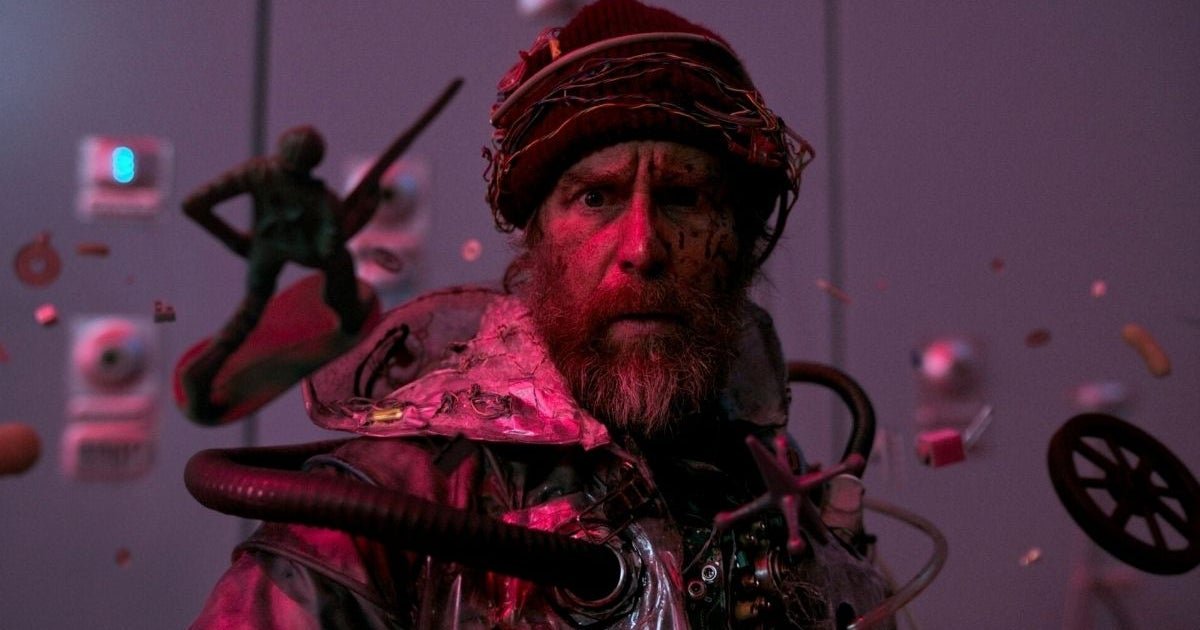
Verbinski is currently doing interviews to promote Good Luck, Have Fun, Don’t Die – a sci-fi movie about Sam Rockwell returning from the future to warn of the perils of AI, which was itself very firmly made without using generative AI.
Watch on YouTube
Asked by But Why Tho (thanks PCGamer) to discuss the state of VFX, based on his long career of making galleons explode, Verbinski observed that “the simplest answer is you’ve seen the Unreal gaming engine enter the visual effects landscape. So it used to be a divide, with Unreal Engine being very good at video games, but then people started thinking maybe movies can also use Unreal for finished visual effects. So you have this sort of gaming aesthetic entering the world of cinema.”
I am immediately fascinated to learn what Verbinski means by a “gaming aesthetic”. All too often, interview answers tail off at this stage. Thankfully, Verbinski kept going.
“I think that’s why those Kubrick movies still hold up, because they were shooting miniatures and paintings, and now you’ve got this different aesthetic,” he said. “It works with Marvel movies where you kind of know you’re in a heightened, unrealistic reality. I think it doesn’t work from a strictly photo-real standpoint.
“I just don’t think it takes light the same way; I don’t think it fundamentally reacts to subsurface, scattering, and how light hits skin and reflects in the same way. So that’s how you get this uncanny valley when you come to creature animation, a lot of in-betweening is done for speed instead of being done by hand.”
Verbinski has seen this transition play out over the course of a trilogy – as he commented, “in the first Pirates movie, we were actually going out to sea and getting on a boat.” I imagine Peter Jackson has similar feelings about the shift in CGI technology over the course of his Tolkien adaptations – there are few sights sadder than Gandalf in a greenroom.
Verbinski noted that many movie studio executives are absolutely fine with all this, because they are creatures of Money who don’t care what real boats look like, but he himself regards the wider adoption of Unreal Engine by movie-makers as a regression. “I think in Good Luck, Have Fun, Don’t Die, we try to be really strict with making at least 50% of the frame photographic,” he said. “I think that keeps you honest. You can use props as a reference, and when you see the CG replacement, you know how to replicate the real thing.
“I think that Unreal Engine coming in and replacing Maya as a sort of fundamental is the greatest slip backwards,” Verbinski continued. “And there’s also something, a mistake I think people make all the time on visual effects. You can make a very real helicopter. But as soon as it flies wrong, your brain knows it’s not real. It has to earn every turn; it has to move right. It’s still animation, sometimes it’s not just the lighting and the photography, sometimes it’s the motion.”
Old man yells at cloud, no doubt, but still, what do you think? In which Unreal Engine-based films do you detect at gaming aesthetic, whatever that means?
Discover more from Dalton Campbells
Subscribe to get the latest posts sent to your email.