

Gordon Bell Prize Finalists Push Open Science Boundaries With NVIDIA-Powered Supercomputers | NVIDIA Blog

Five finalists for the esteemed high-performance computing award have achieved breakthroughs in climate modeling, fluid simulation and more with the Alps, JUPITER and Perlmutter supercomputers.
Announced today at SC25, the finalists’ projects are driving AI and HPC for science using physics simulation, high-precision math and other advanced supercomputing techniques, accelerating breakthroughs across weather forecasting, semiconductor design, space exploration and other fields. Their results are open and accessible on ArXiv.
The supercomputers powering their work include:
Alps — hosted at the Swiss National Supercomputing Centre (CSCS) and powered by more than 10,000 NVIDIA GH200 Grace Hopper Superchips.
Perlmutter — hosted at the National Energy Research Scientific Computing Center (NERSC) and powered by NVIDIA accelerated computing.
JUPITER — Europe’s first exascale supercomputer, hosted at the Jülich Supercomputing Centre (JSC) and powered by the NVIDIA Grace Hopper platform and Quantum-X800 InfiniBand networking.
Your browser does not support HTML5 video.
A rendering of JUPITER supercomputer racks featuring the NVIDIA Grace Hopper platform. Video courtesy of Forschungszentrum Jülich / Sascha Kreklau.

ICON: Modeling Earth at Kilometer-Scale
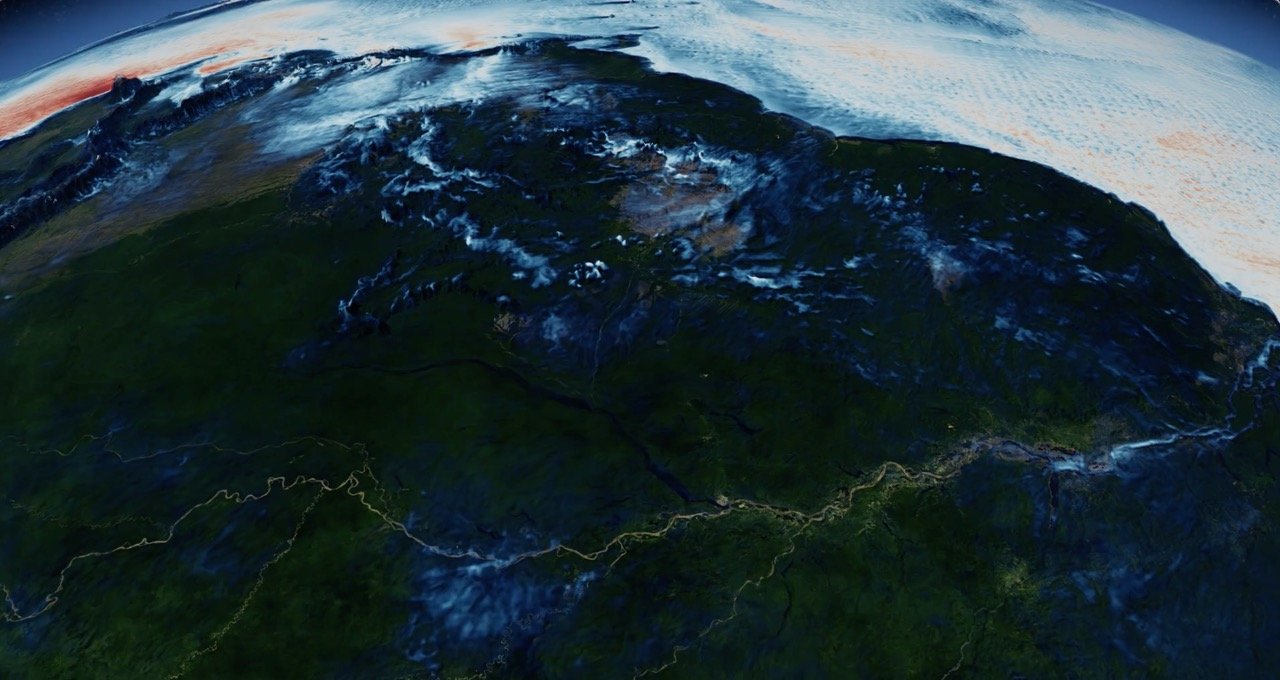
By modeling the entire Earth’s systems at kilometer-scale resolution, ICON can capture the flow of energy, water and carbon through the atmosphere, oceans and land with exceptional detail and unprecedented temporal compression — allowing about 146 days to be simulated every 24 hours — which enables more efficient climate simulations projecting up to decades forward.
Your browser does not support HTML5 video.
A simulation of carbon dioxide flux using the ICON model.
ORBIT-2: Exascale Vision Foundation Models for Weather and Climate Modeling
Tapping into exascale computing and algorithmic innovation, ORBIT-2 overcomes challenges faced by traditional climate models with spatial hyper-resolution downscaling, a technique that creates high-resolution data from lower-resolution sources. This enables teams to capture and predict far more localized phenomena like urban heat islands, extreme precipitation events and subtle shifts in monsoon patterns.
“NVIDIA’s advanced supercomputing technologies enabled ORBIT-2 to achieve exceptional scalability, reliability and impact at the intersection of AI and high-performance computing on NVIDIA platforms,” said Prasanna Balaprakash, director of AI programs and section head for data and AI systems at Oak Ridge National Laboratory.
QuaTrEx: Advancing Transistor Design Through Nanoscale Device Modeling
Running on the Alps supercomputer with NVIDIA GH200 Superchips, QuaTrEx can simulate devices with more than 45,000 atoms with FP64 performance and extreme parallel-computing efficiency. This enables faster, more accurate design of transistors, called NREFTs, that will be crucial for the semiconductor industry.
A simulation of the flow of electrons in a nanoribbon transistor. Video courtesy of ETH Zurich.
Simulating Spacecraft at Record-Breaking Scales With the MFC Flow Solver
Running on the Alps supercomputer, MFC, an open-source solver developed by the Georgia Institute of Technology in collaboration with NVIDIA and others, enables fluid flow simulation 4x faster and with over 5x greater energy efficiency while maintaining the same accuracy as the previous world record. Based on full-scale runs on Alps, MFC is expected to run at 10x the scale of the previous world record on JUPITER. This paves the way for faster, more accurate design of critical components for space exploration.
Your browser does not support HTML5 video.
A rocket engine simulation using computational fluid dynamics. Video courtesy of the Georgia Institute of Technology.
A Digital Twin for Tsunami Early Warning
Applied to the Cascadia subduction zone in the Pacific Northwest, the digital twin accomplished complex computations that would normally take 50 years on 512 GPUs in just 0.2 seconds on the Alps and Perlmutter supercomputers, representing a 10 billion-fold speedup.
“For the first time, real-time sensor data can be rapidly combined with full-physics modeling and uncertainty quantification to give people a chance to act before disaster strikes,” said Omar Ghattas, professor of mechanical engineering at UT Austin. “This framework provides a basis for predictive, physics-based emergency-response systems across various hazards.”
For the tsunami digital twin, ICON and MFC projects, NVIDIA CUDA-X libraries played a key role in maximizing the performance and efficiency of the complex simulations. ICON also taps into NVIDIA CUDA Graphs, which allow work to be defined as graphs rather than single operations.
Learn more about the latest supercomputing advancements by joining NVIDIA at SC25, running through Thursday, Nov. 20.
Discover more from Dalton Campbells
Subscribe to get the latest posts sent to your email.